

Enhanced User Experience
Design Flexibility & Aesthetic Appeal

Cost Optimization Over Product Lifecycle

Future-Proof Product Design
Industrial systems today generate enormous amounts of data — from motors, HVAC units, lab instruments, production lines, and access systems. Sensors continuously measure temperature, vibration, current, pressure, and more.
Yet, having data does not automatically mean having intelligence.
Today, around 65% of IoT deployments already use AI technologies to improve analytics and automation.
In manufacturing and industrial sectors, 71% of organizations are using AIoT for predictive maintenance, shifting from reactive repairs to proactive planning.
Despite this momentum, many companies still face common challenges:
This is where AI changes the game.
AI combined with IoT — often called AIoT — allows systems not just to collect information, but to understand it and act on it.
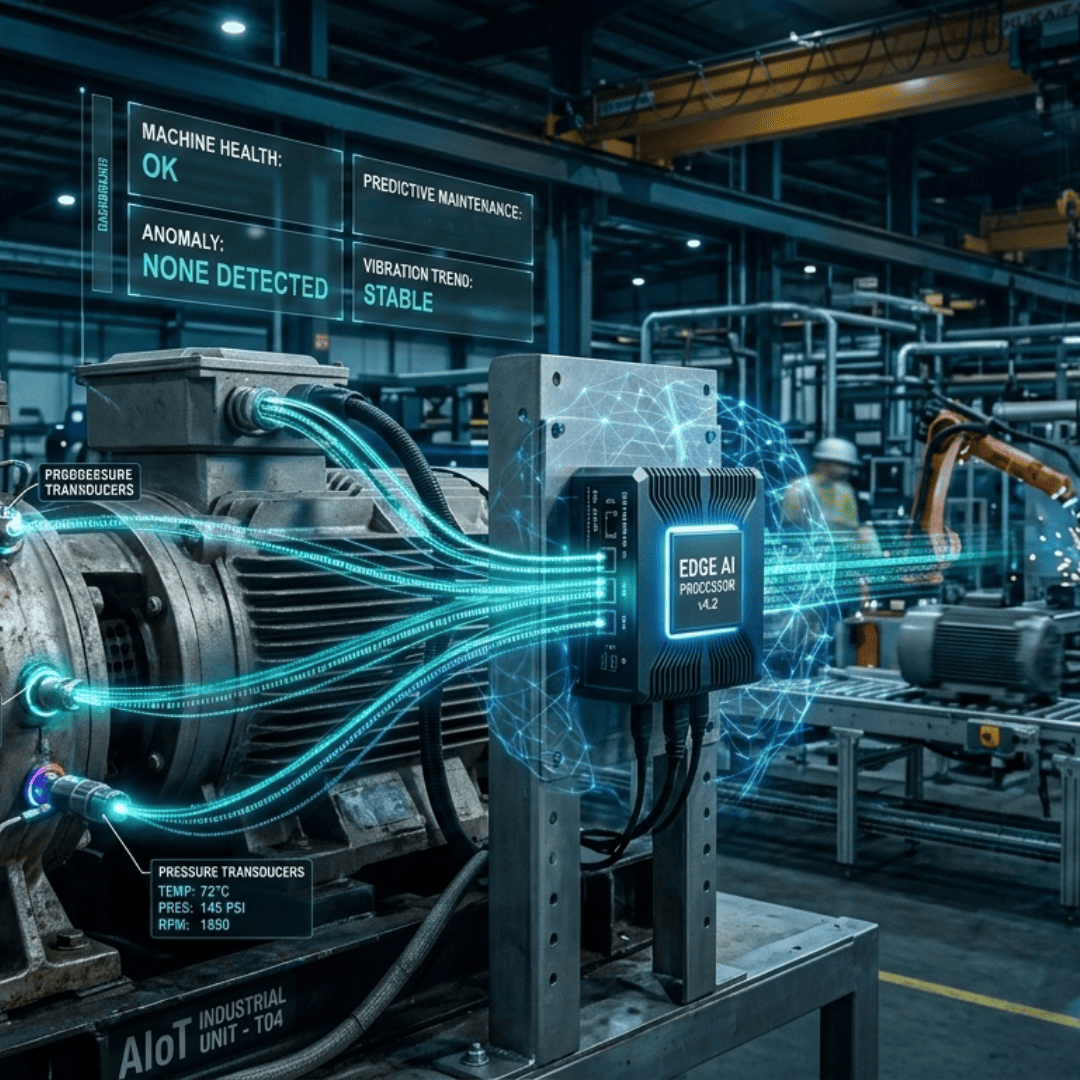
AIoT may sound complex, but its building blocks are straightforward when broken down properly.
Traditionally, IoT systems send data to the cloud for analysis. That works — but it can be slow and costly.
Edge AI moves intelligence closer to the machine itself. Instead of waiting for cloud processing, the device analyzes data locally and makes faster decisions.
Platforms such as NVIDIA provide hardware designed specifically for edge computing. Machine learning frameworks like TensorFlow help build and deploy AI models that can run efficiently on these devices.
Why this matters:
In industrial environments, speed and reliability are critical. Edge AI makes both possible.
Most industries are used to two types of maintenance:
AI introduces a third model: Predictive
By analyzing patterns in vibration, temperature, and electrical signals, AI can identify early warning signs of failure. Instead of waiting for a breakdown, maintenance can be scheduled at the right time.
The result:
This shift alone can significantly impact operational efficiency.
Many IoT systems operate on simple rules: “If temperature crosses X, trigger alert.”
But industrial operations are rarely that simple. Machines behave differently depending on load, environment, and usage patterns.
AI learns what “normal” looks like for a system under different conditions. Instead of reacting to fixed numbers, it detects unusual patterns.
This leads to:
The next step beyond detection is correction.
In more advanced AIoT systems, machines can:
Rather than just reporting problems, the system takes limited corrective actions on its own — within defined safety limits.
This is particularly valuable in remote facilities or distributed industrial setups.
Organizations often underestimate the complexity of embedding AI into IoT systems. Common challenges include insufficient edge processing capacity, suboptimal sensor architecture, fragmented data pipelines, and poorly integrated cloud frameworks.
Alpha ICT addresses these challenges through multidisciplinary product engineering.
Controllers and PCB architectures are designed to support real-time data acquisition, efficient inferencing, and scalable firmware updates.
Robust Data and Model Pipeline Design
Secure device-to-cloud communication, model deployment workflows, and continuous retraining pipelines are architected to ensure long-term scalability.
Validation and Field Reliability
AI-driven systems must perform consistently in real industrial environments. Alpha ICT integrates compliance validation, reliability testing, and field trials into the development lifecycle.

Artificial Intelligence is redefining what connected systems can do.
IoT once focused on visibility — knowing what is happening.
AI adds foresight — knowing what will happen.
The next phase brings autonomy — systems that respond intelligently on their own.
For industrial organizations, the question is no longer whether AI will impact IoT — but how quickly they can embed intelligence into their products and operations.
If your systems are generating data but not delivering insight, the opportunity is clear. The path forward begins with structured engineering, clear use cases, and a scalable AI architecture.