
The global HVAC industry is entering a new phase of product transformation as major markets accelerate the transition toward electrified and energy-efficient heating systems. This shift is redefining HVAC product development, as governments and energy agencies across regions such as the UK and the United States actively promote heat pump adoption as part of broader building modernization and energy optimization initiatives.
In the UK, the government-backed Boiler Upgrade Scheme supports the adoption of low-carbon heating technologies including air source and ground source heat pumps. Similarly, the U.S. Department of Energy continues to promote heat pump technologies through multiple energy-efficiency and innovation initiatives focused on next-generation HVAC systems.
This transition is influencing more than heating technologies alone. It is fundamentally reshaping HVAC systems — changing how products are designed, controlled, validated, connected, and maintained across their lifecycle.
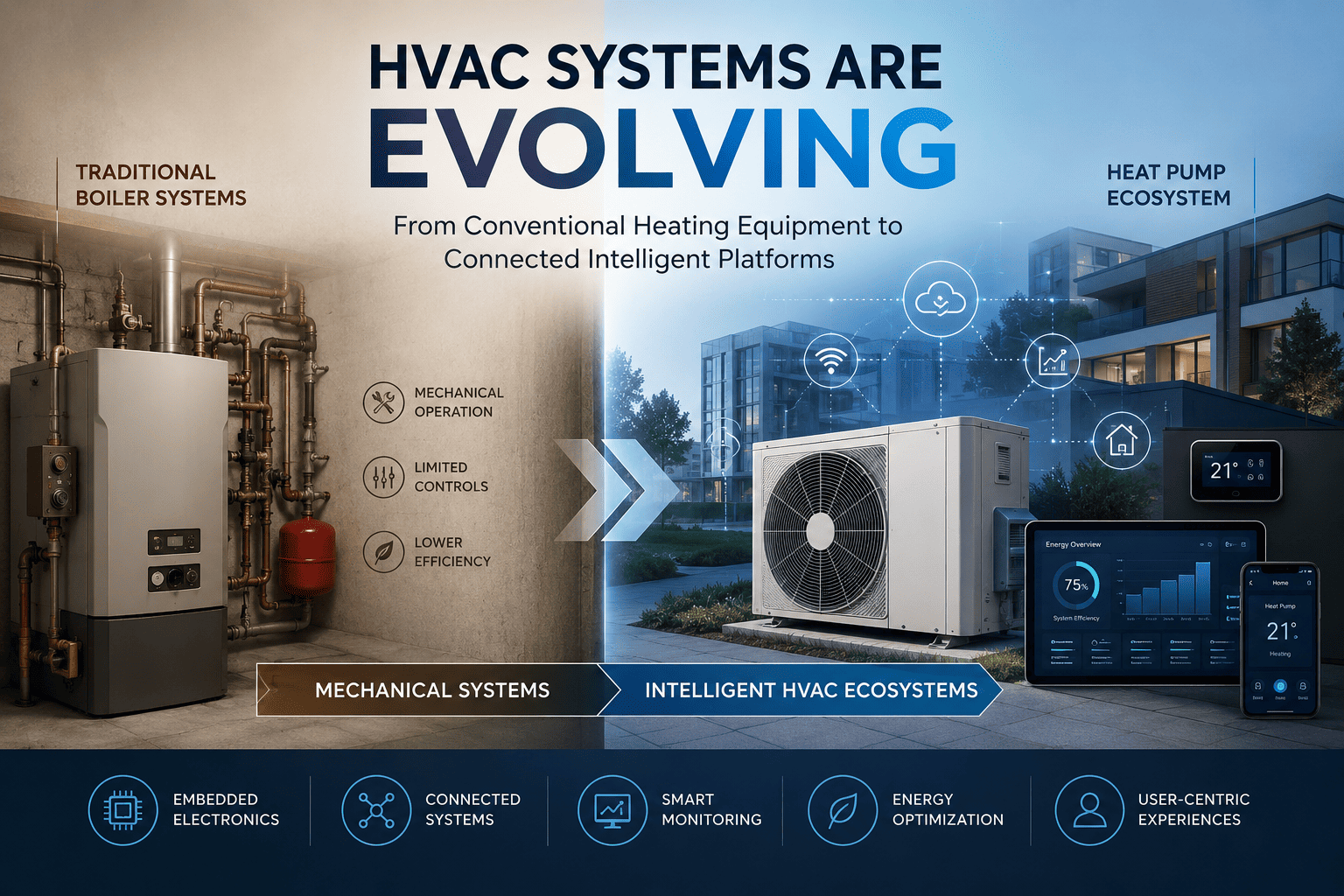
Traditional gas boiler systems were largely centered around thermal and mechanical engineering. Modern heat pump-based systems, however, increasingly depend on embedded electronics, intelligent controls, software-driven optimization, sensor integration, connectivity frameworks, and real-time operational coordination.
As HVAC systems evolve into connected and software-oriented platforms, manufacturers are rethinking product architectures to support:
This shift is driving a broader transformation in HVAC product engineering, where multidisciplinary system integration is becoming increasingly important for next-generation product development.
Heat pump architectures require significantly greater electronic integration compared to traditional heating systems. Embedded controllers, inverter-driven systems, variable-speed compressor management, and intelligent power control mechanisms now play a central role in HVAC operation.
Modern control systems are designed to dynamically optimize performance based on environmental conditions, operational load, and energy-efficiency requirements. This increases the role of embedded electronics in overall HVAC system performance and product differentiation.
The growing adoption of connected HVAC systems is increasing the deployment of smart sensing technologies across heating platforms. Temperature, humidity, pressure, current, vibration, and airflow sensors continuously monitor system behavior and operational efficiency.
At the same time, communication technologies such as Wi-Fi, Bluetooth, Ethernet, MQTT, and Modbus are enabling HVAC systems to integrate with:
Firmware has emerged as a critical component in modern HVAC product development. Intelligent firmware enables system coordination, compressor control, adaptive thermal management, fault handling, and operational optimization.
Many next-generation HVAC systems also incorporate edge-level intelligence that allows devices to process operational inputs locally for faster response times and improved reliability. This supports predictive maintenance workflows, dynamic performance optimization, and automated system adjustments.
The shift toward intelligent HVAC systems is also influencing how users interact with heating products. Modern systems increasingly rely on touchscreen interfaces, cloud dashboards, mobile applications, and simplified digital controls to improve usability and operational visibility.
As HVAC systems become more connected and software-driven, user experience engineering is becoming an increasingly important aspect of product development strategies.
The growing complexity of heat pump-based HVAC architectures is increasing the importance of product validation and system-level testing. Manufacturers must now validate interactions between electronics, firmware, communication modules, sensors, and mechanical subsystems under diverse operating conditions.
Functional testing, reliability engineering, EMI/EMC validation, environmental testing, and field-condition simulation are becoming increasingly important for ensuring long-term operational performance and system stability.
Alpha ICT supports HVAC manufacturers through a concept-to-field product engineering approach designed for connected and intelligent HVAC systems.
Alpha ICT’s capabilities span multiple areas of modern HVAC product development, including:
With expertise across embedded electronics, software applications, communication technologies, and system integration, Alpha ICT helps product companies accelerate the development of scalable and future-ready HVAC solutions aligned with evolving industry requirements.
The transition from gas boilers to heat pumps represents a broader evolution in HVAC product engineering. Heating systems are increasingly becoming intelligent, connected, and software-oriented platforms that require deeper integration between electronics, firmware, connectivity, and system-level engineering.
As HVAC products continue evolving alongside connected building ecosystems and energy-optimization initiatives, manufacturers will increasingly require scalable product architectures capable of supporting intelligent control, remote diagnostics, connected operation, and long-term adaptability.
The next phase of HVAC innovation will not be defined solely by how efficiently systems generate heat, but by how intelligently they operate, communicate, optimize, and evolve within increasingly connected environments.
Information Source: UK Government – Boiler Upgrade Scheme | U.S. Department of Energy – Heat Pump Systems