
HVAC Systems Are Evolving Beyond Traditional Thermal Control
The HVAC industry is entering a new phase of product transformation driven by electrification, energy efficiency goals, connected infrastructure, and intelligent building technologies. Across residential and commercial environments, HVAC systems are increasingly expected to deliver more than heating and cooling. Modern platforms are now being designed to support real-time monitoring, energy optimization, remote diagnostics, and connected user experiences.
This transition is accelerating alongside the growing adoption of heat pumps and low-carbon heating technologies. According to the International Energy Agency (IEA), buildings account for nearly 30% of global energy demand, making energy-efficient HVAC systems a major focus area for future infrastructure development.
In the UK, the Future Homes Standard is further driving this transformation by promoting low-carbon heating systems such as heat pumps and higher-efficiency building technologies. Meanwhile, the U.S. Department of Energy continues to emphasize smart building controls, connected energy systems, and intelligent HVAC optimization as part of grid-interactive efficient building initiatives.
As HVAC products become more intelligent and software-oriented, embedded electronics are emerging as a foundational element in modern HVAC product architecture.
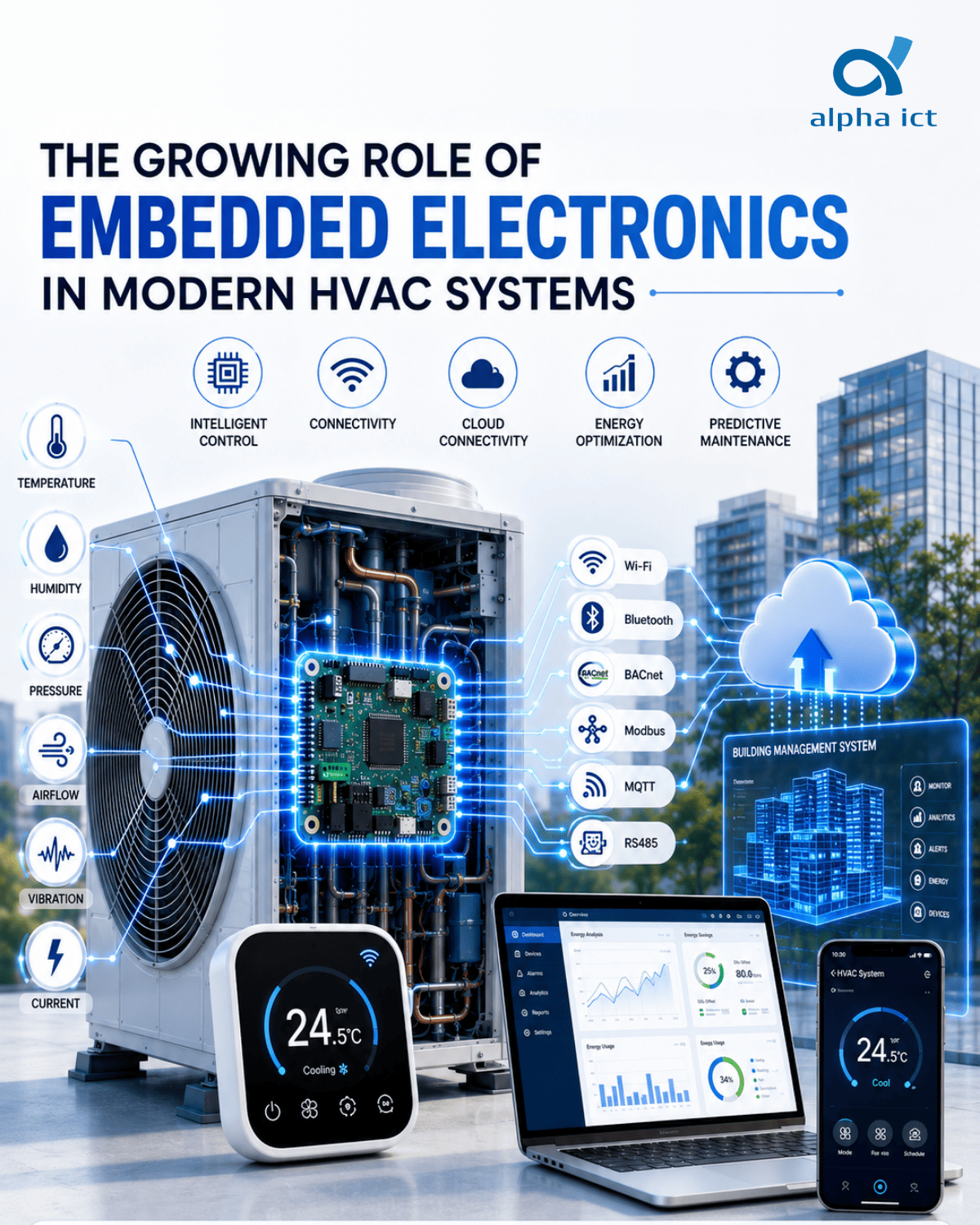
Embedded controllers act as the operational core of modern HVAC equipment. These systems manage compressors, fans, motors, temperature balancing, and overall operational sequencing through firmware-driven logic.
Advanced HVAC systems increasingly rely on microcontrollers and embedded processors to support variable speed operation, inverter technology, and adaptive control mechanisms. This enables HVAC equipment to respond dynamically to changing environmental and operational conditions while maintaining optimized performance.
Modern HVAC systems integrate multiple sensors to continuously monitor system conditions and environmental parameters. Temperature, humidity, airflow, pressure, current, and vibration sensors help HVAC equipment make real-time operational decisions.
Sensor integration also enables predictive diagnostics, intelligent balancing, and enhanced operational stability across connected HVAC platforms. As systems become more energy-focused and data-driven, sensor-based decision-making is becoming central to HVAC product development.
HVAC systems are increasingly functioning as connected ecosystems rather than standalone equipment. This has expanded the role of communication technologies such as Wi-Fi, Bluetooth, Zigbee, BACnet, Modbus, MQTT, and RS485.
These technologies support interoperability between HVAC units, cloud platforms, Building Management Systems (BMS), and mobile applications. Connectivity also enables remote access, centralized monitoring, firmware updates, and data exchange across distributed HVAC infrastructures.
User interaction expectations are evolving significantly in the HVAC industry. Touchscreen interfaces, smart thermostats, mobile applications, and intuitive dashboards are becoming standard requirements across many HVAC platforms.
Modern HMI development focuses on delivering simplified controls, real-time visibility, and user-centric operational experiences. As HVAC systems become more software-driven, interface design is playing a larger role in overall product differentiation.
IoT-enabled HVAC systems are creating new opportunities for remote diagnostics, predictive maintenance, and centralized fleet management. Connected HVAC platforms can collect operational data continuously and transmit it to cloud-based analytics systems.
This architecture supports proactive maintenance strategies, energy consumption analysis, operational optimization, and improved service response capabilities. Cloud-connected systems also allow OEMs and facility operators to gain greater visibility into field performance across deployed products.
Alpha ICT LLP supports HVAC manufacturers through concept-to-field product engineering capabilities spanning embedded electronics, software applications, connectivity, validation, and system-level engineering.
The company’s expertise includes embedded controller development, sensor integration, communication interfaces, HMI engineering, cloud-connected applications, and intelligent HVAC product architectures. Alpha ICT also supports HVAC OEMs through product validation, reliability testing, EMI/EMC testing, and engineering support for product modernization initiatives.
With multidisciplinary capabilities across embedded electronics, software, and connected product engineering, Alpha ICT helps manufacturers accelerate the development of intelligent and future-ready HVAC systems.
The Future of HVAC Systems Will Be Defined by Intelligent Electronics
The next generation of HVAC products will increasingly be shaped by connected intelligence, software-driven functionality, and energy-aware system architectures. Embedded electronics are becoming central to how HVAC equipment is controlled, monitored, optimized, and integrated within broader smart infrastructure ecosystems.
As market expectations continue evolving toward intelligent and connected systems, HVAC manufacturers are expected to place greater emphasis on embedded engineering, system integration, and scalable product architectures that support long-term innovation and operational efficiency.