
Embedded electronics for scientific instruments is redefining how modern laboratories achieve precision measurement, automated workflows, seamless connectivity, and intuitive user experiences. These capabilities help laboratories improve operational efficiency, enhance data integrity, and accelerate informed decision-making across research, healthcare, pharmaceuticals, environmental monitoring, and industrial testing.
Recent industry findings reflect this ongoing transformation. According to the 2025 MLO State of the Industry Survey, 48% of laboratories continue to face interoperability and data integration challenges, while 71% identify staffing and 66% identify funding as major operational concerns. These trends are encouraging the adoption of intelligent, connected laboratory instruments that simplify workflows and improve data accessibility. Similarly, Lab Manager highlights that digital laboratories are increasingly integrating instruments, sensors, and scientific data to improve productivity and collaboration. Supporting this evolution, a 2025 study published by the U.S. National Library of Medicine reports significant growth in software-enabled medical devices over the past two decades, demonstrating the expanding role of embedded electronics and software in modern instrumentation.
Sources:
Embedded electronics forms the intelligence layer of scientific and analytical instruments by integrating hardware, firmware, sensors, communication interfaces, and control software into a unified platform. This integration enables precise control, reliable automation, secure communication, and scalable functionality, allowing manufacturers to develop instruments that align with the evolving needs of modern laboratories and research facilities.

Embedded controllers coordinate every critical function within a scientific instrument, from measurement and data acquisition to system control and user interaction. Depending on application requirements, manufacturers can leverage microcontrollers (MCUs), microprocessors (MPUs), real-time operating systems (RTOS), embedded Linux platforms, or FPGA-based architectures. These processing platforms execute complex control algorithms, manage peripheral devices, and ensure dependable real-time performance for precision laboratory applications.
Capacitive touch interfaces have become the modern replacement for mechanical buttons across industrial, commercial, and consumer products. With their seamless surfaces and high durability, they offer:
Industries like appliances, industrial machinery, medical devices, and automotive interiors increasingly prefer CapSense for its responsiveness, long life, and ergonomic appeal.
Designing Capsense Keypads required specialized expertise in electronics hardware and firmware design with which touch sensitive keypads working in all environmental conditions considering product design constraints can be designed.
High-quality measurements begin with accurate data acquisition. Embedded electronics incorporates precision analog front-end circuits, high-resolution analog-to-digital converters (ADCs), digital-to-analog converters (DACs), signal conditioning, and sensor interfaces to capture measurement data with exceptional accuracy. These technologies support a wide range of sensing applications, including temperature, pressure, optical, chemical, flow, and electrical measurements, enabling consistent and repeatable instrument performance.
Many scientific and analytical instruments incorporate automated sample handling, fluid dispensing, valve control, heating, cooling, and precision positioning. Embedded electronics enables synchronized motor control, actuator management, and process automation to ensure smooth and repeatable operations. Complementing these capabilities are intuitive human-machine interfaces featuring capacitive touch displays, graphical user interfaces, multilingual support, and responsive navigation that enhance usability and improve operator productivity.
Connected laboratory environments benefit from instruments capable of exchanging data with laboratory information systems, cloud platforms, and industrial networks. Embedded firmware supports communication through interfaces such as Ethernet, USB, Wi-Fi, Bluetooth, RS-485, Modbus, MQTT, and OPC UA. Security features including secure boot, encrypted communication, authenticated firmware updates, and diagnostic tools contribute to reliable operation while supporting data protection and long-term maintainability.
Alpha ICT partners with OEMs to develop embedded electronics-driven scientific and analytical instruments through its Concept-to-Field product engineering approach. By bringing together expertise in embedded hardware, firmware, software, mechanical engineering, and product validation, the company supports customers across every stage of product development from concept and architecture to manufacturing readiness.
Our engineering capabilities include precision embedded controller design, sensor integration, data acquisition systems, heating and motion control, HMI development, communication interface integration, embedded firmware development, and cloud-enabled connectivity. These capabilities help manufacturers build intelligent instruments tailored to laboratory automation, analytical testing, and scientific measurement applications.
Alpha ICT also supports product validation, compliance readiness, engineering optimization, component lifecycle management, and manufacturing support. This comprehensive engineering approach enables OEMs to accelerate innovation, improve product quality, and develop scalable scientific instruments that address evolving market requirements with confidence.
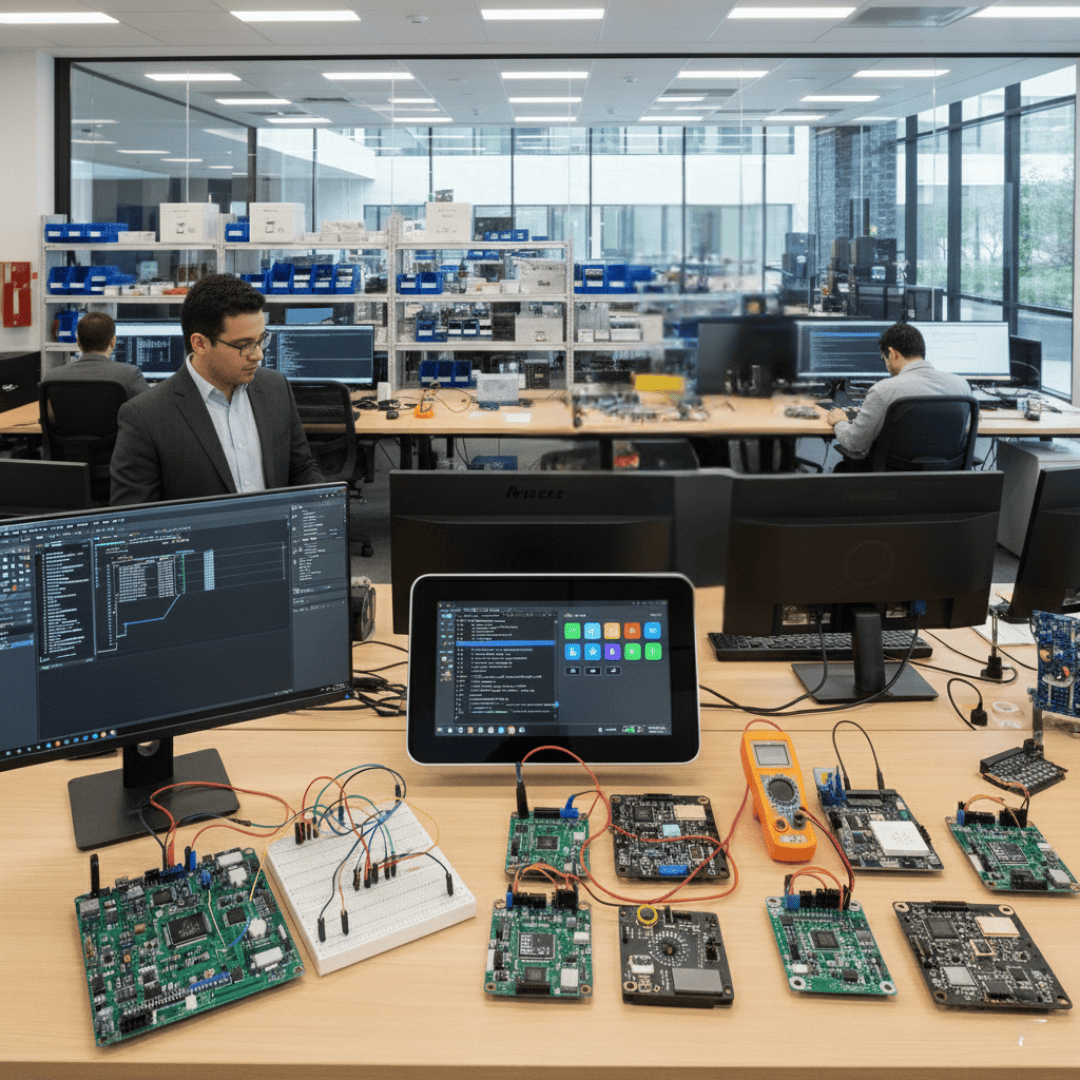
Future-Proof Scientific Instruments with Intelligent Embedded Electronics
Embedded electronics continues to shape the future of scientific and analytical instrumentation by enabling greater precision, connectivity, automation, and scalability. As laboratories embrace digital transformation and connected ecosystems, intelligent embedded systems provide the technological foundation for advanced measurement, efficient workflows, and seamless integration across laboratory environments.
For instrument manufacturers, investing in robust embedded electronics creates opportunities to develop innovative product platforms, introduce advanced capabilities, and respond quickly to emerging technologies and customer expectations. With the right engineering expertise, organizations can build reliable, future-ready scientific instruments that deliver lasting value across their entire product lifecycle.