
HVAC product modernization is becoming a strategic priority as systems play an increasingly important role in improving building energy efficiency, occupant comfort, and sustainability. According to the International Energy Agency (IEA), buildings account for nearly 30% of global energy demand, making energy efficiency a key focus area for building owners, regulators, and equipment manufacturers alike.
At the same time, cooling demand continues to grow globally, while the adoption of heat pumps and electrified heating systems is accelerating. These market shifts are changing expectations for HVAC products. Modern systems are expected to deliver not only heating and cooling performance but also intelligent controls, connectivity, remote accessibility, energy optimization, and seamless integration with broader building ecosystems.
For many HVAC manufacturers, the challenge is not necessarily developing entirely new products. Instead, it is about modernizing proven product platforms to meet evolving customer expectations, regulatory requirements, and competitive pressures. Product modernization allows manufacturers to introduce new capabilities, improve efficiency, enhance user experience, and extend product lifecycles while leveraging existing investments.
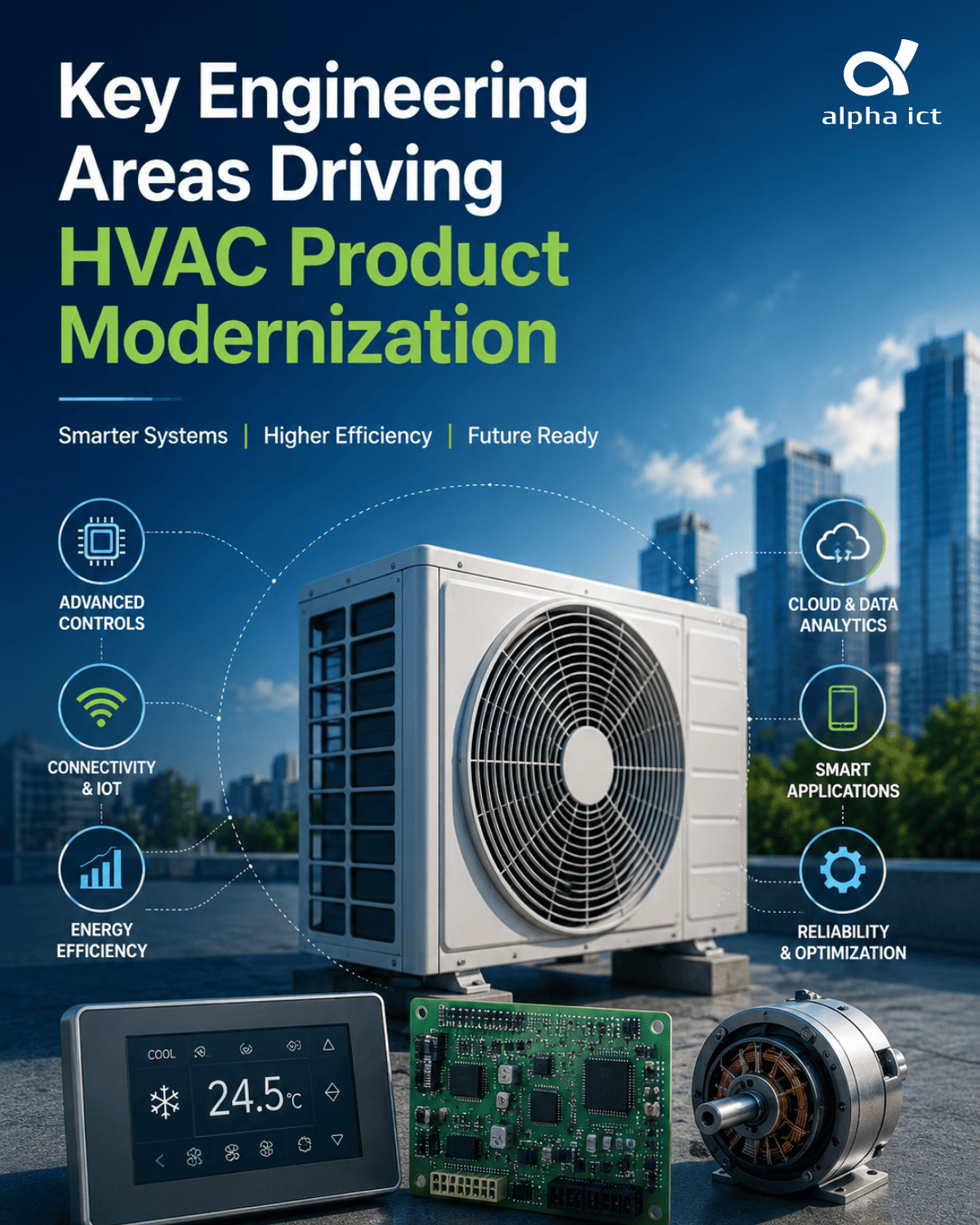
Embedded electronics form the foundation of modern HVAC equipment. Controllers, sensors, communication interfaces, and data acquisition systems enable products to monitor operating conditions and respond intelligently to changing environmental requirements.
As HVAC systems become more sophisticated, control architectures must support a growing number of inputs, outputs, and operating modes. Modern embedded electronics provide the processing capability needed to manage compressors, fans, valves, sensors, and other system components while maintaining efficient and reliable operation.
Firmware serves as the decision-making layer within HVAC systems. It manages system behavior, executes control algorithms, handles fault conditions, and optimizes performance across various operating scenarios.
In parallel, inverter drive technology has become a critical modernization area, particularly in heat pumps and high-efficiency HVAC equipment. Variable speed operation allows compressors and motors to adjust output based on demand rather than operating at fixed speeds.
This approach can improve energy efficiency, reduce operating costs, enhance temperature control, and extend equipment life. As a result, inverter drive engineering is becoming an increasingly important component of modern HVAC product architectures
Connected HVAC systems are rapidly becoming the industry norm. Building owners, facility managers, and service organizations increasingly expect real-time visibility into equipment performance and operating conditions.
Modernization initiatives often introduce communication technologies such as Wi-Fi, Ethernet, Bluetooth, Modbus, BACnet, and cloud connectivity. These technologies enable HVAC equipment to exchange information with building management systems, mobile applications, and cloud-based platforms.
Connectivity also creates opportunities for remote monitoring, diagnostics, software updates, and performance optimization, helping manufacturers deliver greater value throughout the product lifecycle.
The role of software in HVAC products continues to expand. Beyond the embedded controller, many modern HVAC systems now include desktop applications, web portals, mobile apps, and cloud-based dashboards.
These software platforms provide users with access to system configuration, operational data, maintenance information, and performance analytics. They also simplify commissioning, troubleshooting, and service activities.
Equally important is the user interface itself. Modern HMIs are expected to be intuitive, visually engaging, and easy to navigate. Whether integrated directly into equipment or delivered through connected applications, user experience has become an important factor in product differentiation.
Modernization is not always focused on adding new features. In many cases, manufacturers seek to improve product competitiveness through optimization initiatives.
Value engineering helps identify opportunities to reduce product cost, address component obsolescence, improve manufacturability, and streamline product architectures. These efforts can enhance long-term sustainability while maintaining or improving product performance.
As supply chains continue to evolve and electronic components change over time, value engineering has become an important part of maintaining competitive HVAC product platforms.
HVAC product modernization often requires expertise across multiple engineering disciplines. Upgrading a product successfully involves more than introducing a new controller or adding connectivity. It requires the integration of electronics, firmware, software, communication technologies, and product optimization strategies into a cohesive solution.
Alpha ICT supports HVAC manufacturers through product modernization initiatives covering embedded electronics, firmware development, inverter drive engineering, software applications, connectivity enablement, product validation, and value engineering. With experience across HVAC controllers, connected systems, energy optimization solutions, and intelligent product architectures, Alpha helps manufacturers enhance existing platforms while preparing them for future market requirements.
Preparing HVAC Products for the Future
The HVAC industry is continuing its transition toward more intelligent, connected, and energy-efficient systems. As customer expectations evolve and building technologies become increasingly integrated, product modernization is emerging as a strategic priority for manufacturers seeking to remain competitive.
Organizations that proactively modernize their HVAC platforms can improve performance, enhance user experience, extend product lifecycles, and position themselves for the next generation of building technologies.
Explore Alpha ICT’s HVAC Product Engineering capabilities to learn how we support HVAC manufacturers in developing and modernizing intelligent HVAC products.