
New product development for laboratory instruments is advancing rapidly as industries such as pharmaceuticals, biotechnology, healthcare, chemicals, food testing, environmental monitoring, and industrial quality control face increasing pressure to improve productivity, accuracy, traceability, and data accessibility.
This shift is driving significant investment in laboratory automation and digitalization. According to Grand View Research, the global laboratory automation market was valued at approximately USD 8.27 billion in 2024 and is expected to reach USD 18.39 billion by 2033. At the same time, MarketsandMarkets projects the global Laboratory Information Management System (LIMS) market to grow from USD 2.88 billion in 2025 to USD 5.19 billion by 2030, highlighting the growing importance of connected laboratory workflows.
As laboratories become more automated and data-driven, instrument manufacturers are expected to deliver products that go beyond measurement and analysis. Modern laboratory instruments increasingly require advanced electronics, software applications, connectivity, user-friendly interfaces, and seamless integration with broader laboratory ecosystems.
New Product Development (NPD) enables manufacturers to transform emerging scientific requirements and market opportunities into commercial products that address these evolving expectations while supporting long-term product competitiveness.
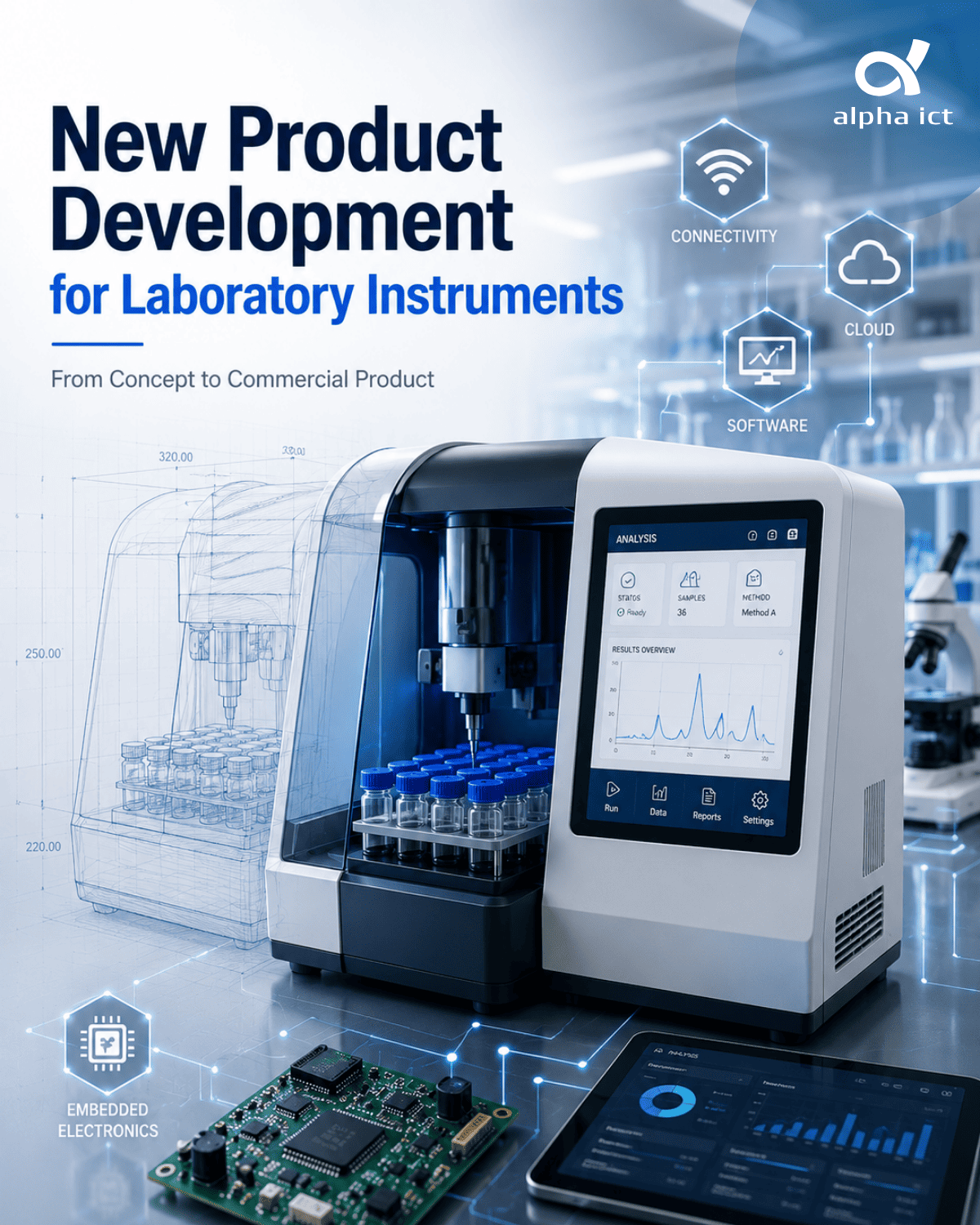
Key Technologies Behind Modern Laboratory Instrument Development
Embedded electronics form the foundation of most laboratory instruments. They enable accurate measurement, instrument control, sensor integration, and data acquisition.
Depending on the application, instrument architectures may include microcontrollers, processor-based systems, analog front-end circuits, signal conditioning electronics, and specialized sensing technologies. These components work together to ensure reliable measurement performance and repeatable operation.
As laboratory instruments become more sophisticated, embedded platforms are also expected to support automation, diagnostics, and communication capabilities alongside their core measurement functions.
The role of software in laboratory instruments continues to expand.
Firmware controls instrument operation, manages measurement processes, executes automation routines, and supports calibration and diagnostics. Software applications extend functionality by enabling data management, reporting, workflow automation, and user interaction.
Modern laboratory equipment increasingly incorporates touchscreen HMIs, intuitive dashboards, graphical data visualization, and advanced reporting tools. These capabilities help simplify operation while improving accessibility to critical measurement and process information.
As user expectations continue to evolve, software is becoming a key differentiator in overall product experience.
Laboratory instruments are no longer expected to operate as isolated systems.
Many laboratories require instruments to exchange information with Laboratory Information Management Systems (LIMS), enterprise software platforms, cloud environments, and centralized databases.
Connectivity technologies such as Ethernet, Wi-Fi, Bluetooth, USB, and cloud communication enable data sharing, remote monitoring, centralized management, and workflow integration.
By supporting connected operations, manufacturers can enhance data accessibility, improve operational efficiency, and create opportunities for value-added digital services.
Developing a modern laboratory instrument requires expertise across multiple engineering disciplines. Success depends on the effective integration of electronics, firmware, software, connectivity, mechanical design, validation, and manufacturing readiness.
Alpha ICT supports laboratory instrument manufacturers throughout the product development journey, from product architecture and embedded electronics development to firmware, software applications, HMI development, connectivity implementation, and product validation.
Our capabilities extend across scientific, analytical, medical, and laboratory automation products, helping OEMs develop new products, enhance functionality, enable connectivity, and prepare solutions for successful manufacturing release.
Whether the objective is developing a new laboratory instrument, automating workflows, improving usability, or building connected product ecosystems, Alpha ICT provides the multidisciplinary engineering support required to accelerate product realization.
Developing a modern laboratory instrument requires expertise across multiple engineering disciplines. Success depends on the effective integration of electronics, firmware, software, connectivity, mechanical design, validation, and manufacturing readiness.
Alpha ICT supports laboratory instrument manufacturers throughout the product development journey, from product architecture and embedded electronics development to firmware, software applications, HMI development, connectivity implementation, and product validation.
Our capabilities extend across scientific, analytical, medical, and laboratory automation products, helping OEMs develop new products, enhance functionality, enable connectivity, and prepare solutions for successful manufacturing release.
Whether the objective is developing a new laboratory instrument, automating workflows, improving usability, or building connected product ecosystems, Alpha ICT provides the multidisciplinary engineering support required to accelerate product realization.
Building the Next Generation of Laboratory Instruments
Laboratory instruments are evolving into intelligent, connected, software-driven platforms that support increasingly automated and data-centric laboratory environments.
For manufacturers, successful new product development requires more than integrating new technologies. It requires bringing together measurement science, electronics, software, connectivity, validation, and manufacturing considerations into a cohesive product strategy.
If you are developing a new laboratory instrument or expanding your product portfolio, the right engineering partner can help accelerate innovation, reduce development risk, and bring products to market with greater confidence.